Summary of this article
- The Dear Leader political phenomenon is not confined to North Korea and America under Trump II. There’s a Dear Leader at just about every political level in just about every country on earth—and has been since Kyoto entered high politics across The West.
- The lesser Dear Leaders pre channeled Trump long before he rode the golden escalator.
- Just as Trump’s lackeys in his cabinet pursue blatantly harmful policies (e.g., tariffs) when he tells them to, the Dear Leaders’ appointees in just about every electric grid in the west obediently follow orders to shoehorn wind, solar, and batteries into their grids, at public expense, on a rationale that is, to put it politely, laughable.
- And just as Trump’s lackeys follow his often-illegal orders for fear of losing the jobs he appointed them to, grid operators follow similarly bad orders for the same exact reason.
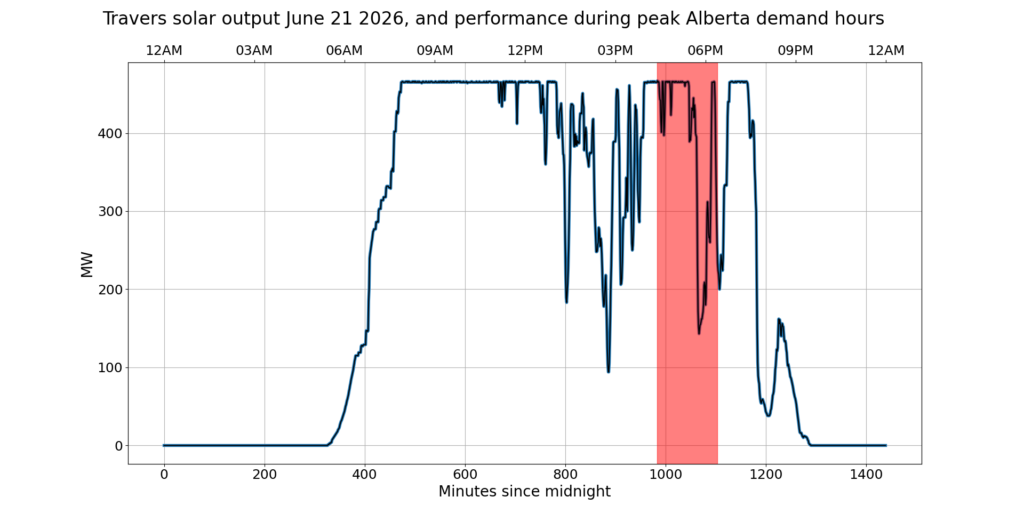
The Travers solar farm near Vulcan Alberta, at 465 MW total generating capacity, is the biggest solar PV project in Canada. On June 21 2026—the first day of summer—Travers had a “good” day. It generated over 5.8 million kilowatt hours, all of which went into the provincial grid at the time of generation.
I say Sunday June 21 2026 was a “good” day for Travers because in the two hours on either side of Alberta’s peak electrical demand for that day—which was 10,482 MW and occurred after 5PM—Travers’s mean output was 390 MW with a standard deviation of 107. Mean demand was 10,388, with std of 25. At one point in those two hours, Travers’s output plunged more than 300 MW—65 percent of the station’s capacity—in about 35 minutes; at another, the same amount in about 25 minutes. Each of those two drops were followed by spikes of similar magnitude and time. See the plot (peak demand hours shaded red).
Proponents of solar power typically follow a well-rehearsed script in response to those who criticize solar for this kind of erratic and unpredictable behaviour. First, they dismiss the behaviour as if it’s irrelevant. Then when pressed by someone who knows an unscheduled 300-MW drop in output is neither trivial nor irrelevant, they say that somewhere the wind is blowing and will compensate for the 300-MW loss. Then, when an informed interlocutor points out that’s not anything anybody would bet real money on, they claim that soon batteries will solve the problem.
They play this script with such confidence and certitude that senior politicians of all stripes not only buy into and then evangelize the solar ideology but do so with similar confidence, certitude, and enthusiasm. And when the evangelical politician issues directives to grid operators to put solar onto their grids, the operators do so because to disobey means to offend the evangelical politician who’s suddenly also a snowflake who cannot abide disagreement and certainly none from anybody who knows what they’re talking about.
None of the 5.8 million kWh Travers generated on the first day of summer 2026 was stored in batteries. Alberta’s total grid-connected battery storage amounts of 495,000 kWh, less than one-tenth of Travers’s total energy output on June 21. Travers generating at full power would fill this capacity in 64 minutes, assuming a charging rate equal to Travers maximum output (which is impossible).
Casual readers may be surprised to learn this figure, to learn that, after the endless decades-long hype about solar and batteries, Alberta’s total storage is about a tenth of a single solar farm’s output in a single day. There’s a reason for this. Cost per kWh of grid-scale lithium-ion batteries is CAD$161 (US$115 in 2024, according to IEEE), which would bring overnight capital cost of the portion of the battery pack required to store all Travers’s June 21 output to $935 million.
It gets worse. That portion—the portion of the mythical battery pack that stores all the electrical energy Travers generated on June 21—is nowhere close to the actual size of the battery pack required. A 5.8 million kWh battery pack could not store Travers’s output as the rate that output was generated. For that, a pack four to five times 5.8 million kWh would be required. So overnight capital cost would be at least $3.74 billion.
And that’s why there’s only 495,000 kWh of battery storage on Alberta’s grid in spite of all the battery hype. Discharging at its maximum rate of 270 MW represents about 2.6 percent of the peak Alberta demand on that day. It can’t even discharge at that rate for two hours.* This is not energy storage so much as poseury. But at $76 million (495,000 x $161), instead of the $3.7 billion to store just Travers’s June 21 output, it’s affordable poseury. Dear Leader gets to tick the green box, and the ratepayers don’t show up at the AESO with pitchforks.
Google “grid-scale battery energy storage” and you get page after page after page of corporate brochure copy crowing about “falling solar costs” and other such false and misleading advertising. Large language models are trained on this, hence AI-driven Google searches are just an amplified echo chamber: garbage in, garbage out—only louder.
The echo chamber is reinforced and expanded, in a positive feedback loop, by elite consultancies like BCG, McKinsey, and others, whose websites repeat as gospel truth the blather about falling costs and future industrial economies where freight rail and steelmaking are powered with wind and solar. Media reporters take this Ivy League endorsement as evidence, which is why we see so little debunking in the mainstream media of the false advertising.
This “consensus,” in which Google-amplified volume stands in for due diligence, common sense, and arithmetic, serves as an easy box to tick for politicians pandering to constituencies weaned on, and demanding more of, the pap that Google and now AI serve up.
And grid operators, receiving directives from political masters who think frequency, voltage, and non-correlation with demand are things to be overcome with political will, obey the directives knowing few if any will crunch the easy arithmetic and expose the whole thing as a silly fairy tale.
And what of the two sudden 300 MW drops in Travers’s output as Alberta entered its peak demand period on that day? The grid operator doesn’t dispatch generation to cover the flaky output of each solar plant; who knows when a cloud will obscure all or some of the panels, reducing output by up to 35 percent. Rather, the operator dispatches generation to meet net demand: demand minus wind-plus-solar.
While all synchronous (non-wind, non-solar) generation in the system contributes to this, there’s a class of supply that really gets a workout delivering the bulk of this response instantaneously. In Alberta, that’s the BC and Montana export/import interties, the hydro generators, Suncor’s Base Plant gas-fired cogen, ENMAX’s gas-fired Sheperd combined cycle, and about nine others, all gas fired.
Everything that the AI- and Google-amplified corporate brochures falsely claim batteries are doing, these 16 sources/sinks are actually doing. Most are either combustible-fuelled, or wheel in power from predominantly combustible-fuel grids (the Montana intertie). All are synchronized: they spin at RPMs that are whole-number multiples of 60 (the frequency of the grid), with very narrow tolerances. Their tolerances are narrower than those a trained human ear can discern when listening to a voice choir. You could say the synchronous generators on a grid are the choir, and demand is the audience. The 16 sources of supply are the principal singers. Wind and solar are bad singers (literally, cannot hit the right notes at the right time), and should not even be on the grid.
In March 2011, one of the most powerful earthquakes in recorded history struck the tectonic plates under the Pacific off the east coast of Japan, raising a tsunami that wiped out hundreds of coastal communities, killing upward of 20,000 people. It also disabled backup power at the Fukushima nuclear plant, triggering meltdowns at three of the plant’s six reactors. Nobody died or was even hospitalized due to the radiological releases the meltdowns caused. Yet ten thousand kilometers away, in Germany, chancellor Angela Merkel, facing state elections in which the Nuclear Meltdown [cue the scary music] for some reason figured prominently, caved to ideological anti-nukes in her governing coalition and reversed herself on her predecessor’s nuclear phaseout, which she had recently said she would rescind.
Merkel’s new policy was to double down on energiewende, which was based on the fantasy that Germany would eschew fossil fuels and transition to wind and solar. Merkel knew this was a fantasy, but guessed, correctly, she could carry on the charade by doubling down on Germany’s actual prime energy source, which was natural gas from Russia, and that nobody would complain. The fact that Russia’s dictator Vladimir Putin was a known war criminal and revanchist bent on aggressive imperial expansion was barely a concern. Merkel approved a new gas pipeline from Russia six months following Putin’s 2014 invasion of the sovereign nation of Ukraine.
The German and international media ignored Ukraine. Instead they celebrated Merkel and engergiewende pretty much uncritically. Merkel’s complicity in the full-scale Ukraine invasion of 2022 was noted, but belatedly—Merkel had long since left power. (To this day she refuses to accept any responsibility for this, and indeed refuses to even acknowledge that her energy policy was a laughable failure.)
Was Merkel’s coddling and forbearance of Putin’s aggression and war crimes due to her caving to anti-nukes, which literally necessitated natural gas—the cheapest of which was from Russia—as the basis of Germany’s energy? Or was it simply a continuation of Ostpolitik, a pro-Russia trend in German foreign policy that had started in the early 1970s? I think both, but it’s pretty clear and beyond debate that Merkel’s inane energy policy, which was a failure of intellectual and political leadership, was the immediate cause of her collusion with Russia. Without heat, German residential water pipes would freeze in winter.
And German (and world) media, elites, and grid operators cheered the Dear Leader’s inane energy policy.
Just as Trump’s Department of Commerce, Department of Justice, and everyone and anyone he’s appointed to whatever position won’t tell him
- tariffs are idiotic,
- prosecuting David Hearn over the Reflecting Pool was illegal, and
- Biden won the 2020 election fair and square,
nobody at any ISO will tell their Dear Leader renewable energy is a fairy tale peddled by con artists. It’s true that the hokum underpinning Trump’s mythology is more obvious to more people than Dear Leaders’ RE and battery fixation. But it’s no less hokum.
Travers in its website claims its farm, which cannot generator any power after about 8PM or before 5:30 AM on the day of the year with the best potential solar resource, “provide a clean source of energy to approximately 200,000 homes.” After literally decades of con artistry based on precisely these kinds of false claims, the renewables industry is not about to stop now.
And Dear Leader is fine with that.
- This point is quite moot, since all Alberta’s batteries contributed a maximum of 28 MW on June 21, for 107 minutes starting at 2:04AM, fifteen hours before the demand peak. Obviously this had nothing to do with serving peak demand with low-cost supply. Solar-and-batteries proponents claim solar is low cost, then pitch it as a get-rich-quick scheme for rent-seeking practitioners of financial witchcraft. The latter, not ratepayers, are the beneficiaries. This article, on the Canadian Climate Institute website, typifies this approach.