In brief:
- North Korea has nuclear bombs because NPT weapons states and United Nations Security Council permanent members China and Russia gave it the technical information and know-how, and possibly materials, necessary for a working bomb.
- North Korea now wants to expand its arsenal of plutonium weapons, and for this it needs to expand its capacity to enrich uranium.
- Russia has all the materials, equipment, and know-how North Korea needs to realize its nuclear expansion dream. Most important, Russia is so desperate for military assistance in the war it started with Ukraine, that it will give pretty much anything, including centrifuges, to anybody, including North Korea—in spite of its signature on the NPT swearing to never do anything like that.
- In August 2024, Ukraine invaded the Russian province of Kursk, presenting both an enormous military problem, and enormous embarrassment, for the country that had started the war. Russia begged North Korea to send troops, in addition to the heavy guns, ammunition, and missiles it was already providing, to help expel the Ukrainians from Kursk; Russia did not have the capability to do that on its own.
- When North Korea in 2022 began materially supporting Russia in Ukraine, it was speculated that nuclear weapons information, know-how, and possibly materials, would be Russia’s quid pro North Korea’s quo.
- On September 10 2026, The Guardian reported that western intelligence has assessed that North Korea has constructed a new facility for separating uranium isotopes. North Korea was reported to have increased its materiel and manpower support to Russia in mid-2026.
On June 25 1950, North Korea, encouraged by the Soviet Union, invaded South Korea, setting off a horrific war in which around 2 million died, many of them civilians. Canada fought in that war, on the side of the United Nations. The UN viewed North Korea’s action as violating the recently signed UN Charter, which made it a war crime to engage in military aggression against a sovereign state.
Over 500 Canadians lost their lives in Korea. Their sacrifice is memorialized in the National War Memorial in Ottawa, the Wall of Remembrance in Brampton Ontario, and other places. It was the first instance in Canada’s history, and the histories of the other UN members that sent troops, where the war aim was explicitly to redress an overt illegality. U.S. president Truman called it a “police action.”
Though the Soviet dictator Stalin supported North Korea, and had encouraged it to stage its unprovoked aggression against the south, the UN resolutions authorizing military force to oppose North Korea were silent on this fact. The USSR was a UN Security Council permanent member, and could veto any resolution. In order to expeditiously secure a favourable vote on the UNSC (which the Soviets at the time were boycotting in protest over recent resolutions on Taiwan following the communist takeover of China), the drafters of the resolutions approving a military response in Korea kept any mention of Soviet complicity out of those documents. But Soviet complicity was obvious, and well understood at the time.*
Stalin birthed the war, emboldened by both his successful nuclear weapons test in August 1949, and his communist clients’ victory in China literally 33 days later. And Stalin’s death in March 1953 effectively ended the war, in an armistice agreed in July that year. That armistice continues to this day.
Stalin had provided heavy military assistance to both the Chinese communists and North Koreans, and much of that assistance was in the form of American equipment provided to the USSR under Lend-Lease during World War II to defeat Stalin’s former partner and ally Nazi Germany.
Understanding this context is vital for understanding the historical backdrop against which the international “anti-proliferation” regime was codified in the NPT in 1968. One of the eventual NPT weapons state signatories, the USSR, had acquired its nuclear capabilities by way of technological secrets stolen from the U.S. The USSR immediately used its new bomb as an insurance policy to protect it from the consequences of okaying an illegal war of aggression in Korea in which millions died, including tens of thousands of Americans and hundreds of Canadians.
The USSR during the 1950s also launched a program of nuclear cooperation with China, enabling that country’s very rapid development of a thermonuclear weapon by 1964, by which time it was bitter enemies with the USSR.*
So, to recap:
- U.S. military aid rescued the USSR from the invasion by Nazi Germany, the USSR’s former ally and partner in starting WWII.
- In spite of the USSR’s complicity in starting WWII (long suspected but not known for sure until Gorbachev admitted it five decades later), American policy elevated the USSR to a permanent member of the Security Council of the newly created United Nations.
- The USSR donated American-origin military equipment to both the Chinese communists and North Koreans.
- The USSR used blueprints stolen from the Manhattan Project to build its own nuclear weapon.
- The USSR helped the Chinese communists overthrow the government of another UN Security Council permanent member.
- The USSR permitted North Korea to start a war against South Korea, in which Americans fought against enemies indirectly armed by America itself, via Lend-Lease to the USSR in WWII.
- The U.S. in 1968 joined with the USSR and communist China, two aggressive nuclear armed totalitarian regimes, in designing an international anti-proliferation treaty wherein those two regimes promised to stop doing what they had been doing up to the moment of signature, but continued doing and continue to do to this very day.
Nobody today would expect the U.S. under Trump to lift a finger or even utter a word of disapproval for the country whose unprovoked war of aggression took 33,000 American, and roughly two million total, lives, and which now invades Europe alongside its criminal ally Russia. But we might expect representatives of the 15 other UN members that sent troops to Korea—Belgium, Australia, the UK, France, the Netherlands, Turkiye, and Canada, among others—to publicly voice at least disapproval, let alone alarm and condemnation, concerning this remarkable fact. And maybe even say a word or two about the obvious quid pro quo of Russian nuclear equipment and know-how for North Korean troops and equipment to enable yet another unprovoked war of aggression, this time in Europe.
The Treaty on the Non Proliferation of Nuclear Weapons was indeed a grand bargain. Three nuclear armed major world powers, two of them aggressive totalitarian dictatorships with well-known records of horrific human rights violations on an unprecedented scale, agreed to attempt to preserve their monopoly on nuclear weapons—essentially to keep them safe as they pursued further imperialist revanchist projects. The totalitarians for the next half century illegally funnelled nuclear weapons technology and know-how to North Korea, the country that started the Korean War.
And the third partner in this unholy trinity, the United States, 57 years later, threw in with the totalitarians and is friendly with their Korean client.
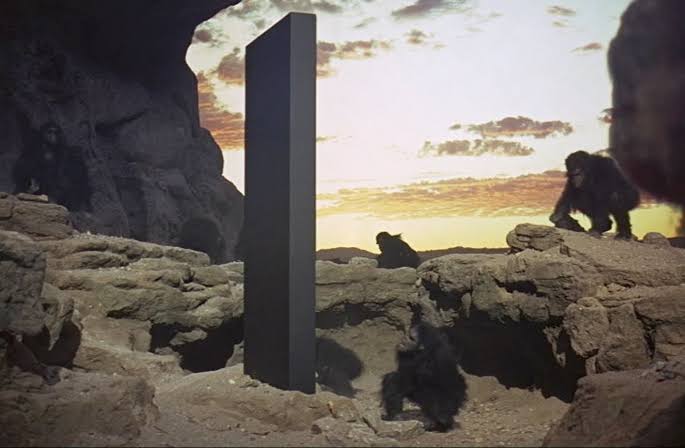
And Canada, together with the NPT non-weapons states, continues to treat the NPT with the same awe and reverence as the apes in 2001: A Space Odyssey treated the monolith.
- The false charges by China and the USSR in 1951 that the U.S. had engaged in germ warfare were precisely to distract western public attention from the original sin of the war, which was that North Korea, encouraged by the Soviet Union, had launched an unprovoked war of aggression not even five years following the creation of the UN and the signing of the UN Charter.
- In March 1969, 8 months after signing the NPT, the USSR and China nearly came to nuclear blows in a border war over disputed territory in the Far East. The Chinese Cultural Revolution was in its darkest phase at the time, and Chinese border units, inflamed with ferocious anti-Russian propaganda from Beijing, were essentially uncontrollable.